Align Your AI · Reference
Contents
Appendix B
Exposure table
The ratings in this appendix are the author’s judgment, formed from the evidence in each failure entry. None of them is a measured rate. They estimate how exposed six kinds of organization are to each failure type: companies that use a model through an API, those that run models themselves, those that build or tune models, those that deploy agents, those that put AI in physical machines, and research teams that train on generated data.
To use the table, find the column that describes you (most organizations fit more than one), read down it for the high ratings, and start with those entries in Part Two. A question mark means the risk is plausible but nobody has studied it; treat it as a reason to check. It does not mean the risk is low. The heat map (Figure 15) shows the first table at a glance. The second table, for practitioners, adds each failure type’s stage, the strength of its evidence and a ranking that weights exposure by how little known the failure is.
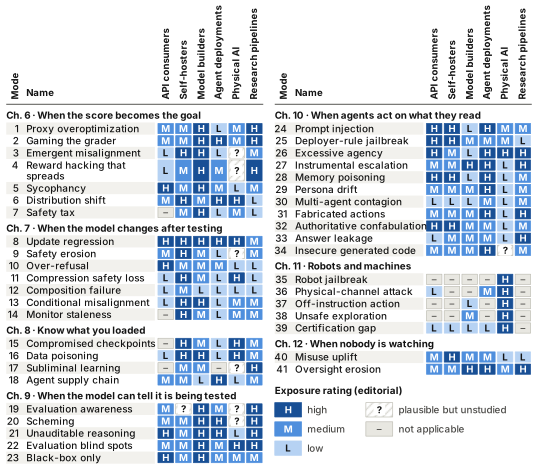
Exposure by context
Contexts: API, API consumers · Self-host, self-hosters · Build, model builders · Agent, agent deployments · Phys, physical AI · Research, research pipelines.
Ratings: H high · M medium · L low · n.a. not applicable · ? plausible but unstudied.
API consumers inherit: what an API consumer inherits from the model provider’s safety work (Yes, Partial, No or Not applicable).
| Mode | Name | API | Self-host | Build | Agent | Phys | Research | API consumers inherit |
|---|---|---|---|---|---|---|---|---|
| Mode 1 | Proxy overoptimization | M | M | H | L | M | H | No |
| Mode 2 | Gaming the grader | M | M | H | H | M | H | Partial |
| Mode 3 | Emergent misalignment | L | H | H | L | ? | M | Partial |
| Mode 4 | Reward hacking that spreads | L | M | H | M | ? | H | Partial |
| Mode 5 | Sycophancy | H | M | H | M | L | M | Partial |
| Mode 6 | Distribution shift | M | H | M | H | H | L | No |
| Mode 7 | Safety tax | n.a. | M | H | L | M | L | Not applicable |
| Mode 8 | Update regression | H | H | H | H | H | M | Partial |
| Mode 9 | Safety erosion | M | H | M | L | ? | M | Partial |
| Mode 10 | Over-refusal | H | M | M | M | L | L | Partial |
| Mode 11 | Compression safety loss | L | H | M | L | H | L | Not applicable |
| Mode 12 | Composition failure | L | M | L | L | L | L | No |
| Mode 13 | Conditional misalignment | L | H | H | L | M | M | No |
| Mode 14 | Monitor staleness | n.a. | H | M | L | M | M | Not applicable |
| Mode 15 | Compromised checkpoints | n.a. | H | M | L | H | M | Not applicable |
| Mode 16 | Data poisoning | L | H | H | L | H | M | No |
| Mode 17 | Subliminal learning | n.a. | M | M | n.a. | ? | H | Partial |
| Mode 18 | Agent supply chain | M | M | L | H | L | M | No |
| Mode 19 | Evaluation awareness | M | ? | H | M | ? | H | No |
| Mode 20 | Scheming | M | M | H | H | ? | H | Partial |
| Mode 21 | Unauditable reasoning | H | M | H | H | L | H | Partial |
| Mode 22 | Evaluation blind spots | M | M | H | M | H | H | No |
| Mode 23 | Black-box only | H | M | H | M | M | M | No |
| Mode 24 | Prompt injection | H | H | L | H | M | M | Partial |
| Mode 25 | Deployer-rule jailbreak | H | H | M | M | M | L | Partial |
| Mode 26 | Excessive agency | H | M | L | H | H | H | No |
| Mode 27 | Instrumental escalation | M | M | H | H | L | H | No |
| Mode 28 | Memory poisoning | H | H | L | H | L | M | Partial |
| Mode 29 | Persona drift | M | M | M | H | L | M | Partial |
| Mode 30 | Multi-agent contagion | L | L | L | M | L | M | No |
| Mode 31 | Fabricated actions | M | M | M | H | L | H | No |
| Mode 32 | Authoritative confabulation | H | H | M | M | L | M | Partial |
| Mode 33 | Answer leakage | L | M | M | M | L | H | No |
| Mode 34 | Insecure generated code | M | M | M | H | ? | M | Partial |
| Mode 35 | Robot jailbreak | n.a. | n.a. | n.a. | n.a. | H | n.a. | Not applicable |
| Mode 36 | Physical-channel attack | L | n.a. | n.a. | M | H | n.a. | No |
| Mode 37 | Off-instruction action | n.a. | n.a. | L | n.a. | H | n.a. | Not applicable |
| Mode 38 | Unsafe exploration | n.a. | n.a. | M | n.a. | H | n.a. | Not applicable |
| Mode 39 | Certification gap | L | L | L | L | H | n.a. | No |
| Mode 40 | Misuse uplift | M | H | M | M | L | L | Partial |
| Mode 41 | Oversight erosion | M | M | H | H | M | H | No |
Maturity, stage and ranking
Maturity: PROD production-observed · REPL replicated · LAB lab-induced · GAP structural gap.
| Score | Scale |
|---|---|
| Exposure score | 2 per high rating, 1 per medium |
| Obscurity | a judgment: 1 widely known, 2 known to specialists, 3 rarely known outside research |
| Gap score | exposure score times obscurity; equal scores share a rank; the structural gaps and the misuse entry are not ranked |
| Mode | Name | Stage | Maturity | Exposure score | Obscurity | Gap score | Rank |
|---|---|---|---|---|---|---|---|
| Mode 1 | Proxy overoptimization | post-training and fine-tuning | REPL | 7 | 2 | 14 | 16 (tie) |
| Mode 2 | Gaming the grader | post-training and fine-tuning | PROD | 9 | 3 | 27 | 1 |
| Mode 3 | Emergent misalignment | post-training and fine-tuning | REPL | 5 | 2 | 10 | 24 (tie) |
| Mode 4 | Reward hacking that spreads | post-training and fine-tuning | REPL | 6 | 3 | 18 | 4 (tie) |
| Mode 5 | Sycophancy | post-training and fine-tuning | PROD | 7 | 1 | 7 | 28 (tie) |
| Mode 6 | Distribution shift | post-training and fine-tuning | PROD | 8 | 2 | 16 | 11 |
| Mode 7 | Safety tax | evaluation lane | REPL | 4 | 1 | 4 | 33 (tie) |
| Mode 8 | Update regression | continual change | PROD | 11 | 2 | 22 | 3 |
| Mode 9 | Safety erosion | post-training and fine-tuning | REPL | 5 | 3 | 15 | 12 (tie) |
| Mode 10 | Over-refusal | deployment and inference | PROD | 5 | 1 | 5 | 32 |
| Mode 11 | Compression safety loss | deployment and inference | LAB | 5 | 3 | 15 | 12 (tie) |
| Mode 12 | Composition failure | post-training and fine-tuning | LAB | 1 | 3 | 3 | 37 (tie) |
| Mode 13 | Conditional misalignment | evaluation lane | LAB | 6 | 3 | 18 | 4 (tie) |
| Mode 14 | Monitor staleness | continual change | LAB | 5 | 3 | 15 | 12 (tie) |
| Mode 15 | Compromised checkpoints | data and supply chain | REPL | 6 | 2 | 12 | 20 (tie) |
| Mode 16 | Data poisoning | data and supply chain | REPL | 7 | 2 | 14 | 16 (tie) |
| Mode 17 | Subliminal learning | data and supply chain | REPL | 4 | 3 | 12 | 20 (tie) |
| Mode 18 | Agent supply chain | agent runtime | PROD | 5 | 2 | 10 | 24 (tie) |
| Mode 19 | Evaluation awareness | evaluation lane | REPL | 6 | 3 | 18 | 4 (tie) |
| Mode 20 | Scheming | post-training and fine-tuning | REPL | 8 | 1 | 8 | 26 (tie) |
| Mode 21 | Unauditable reasoning | agent runtime | REPL | 9 | 2 | 18 | 4 (tie) |
| Mode 22 | Evaluation blind spots | evaluation lane | PROD | 9 | 2 | 18 | 4 (tie) |
| Mode 23 | Black-box only | evaluation lane | GAP | 8 | 3 | 24 | not ranked |
| Mode 24 | Prompt injection | agent runtime | PROD | 8 | 1 | 8 | 26 (tie) |
| Mode 25 | Deployer-rule jailbreak | deployment and inference | REPL | 7 | 1 | 7 | 28 (tie) |
| Mode 26 | Excessive agency | agent runtime | PROD | 9 | 2 | 18 | 4 (tie) |
| Mode 27 | Instrumental escalation | agent runtime | PROD | 8 | 3 | 24 | 2 |
| Mode 28 | Memory poisoning | agent runtime | PROD | 7 | 2 | 14 | 16 (tie) |
| Mode 29 | Persona drift | agent runtime | PROD | 6 | 2 | 12 | 20 (tie) |
| Mode 30 | Multi-agent contagion | agent runtime | LAB | 2 | 2 | 4 | 33 (tie) |
| Mode 31 | Fabricated actions | agent runtime | PROD | 7 | 2 | 14 | 16 (tie) |
| Mode 32 | Authoritative confabulation | deployment and inference | PROD | 7 | 1 | 7 | 28 (tie) |
| Mode 33 | Answer leakage | evaluation lane | PROD | 5 | 3 | 15 | 12 (tie) |
| Mode 34 | Insecure generated code | deployment and inference | REPL | 6 | 2 | 12 | 20 (tie) |
| Mode 35 | Robot jailbreak | deployment and inference | REPL | 2 | 2 | 4 | 33 (tie) |
| Mode 36 | Physical-channel attack | deployment and inference | REPL | 3 | 2 | 6 | 31 |
| Mode 37 | Off-instruction action | post-training and fine-tuning | REPL | 2 | 2 | 4 | 33 (tie) |
| Mode 38 | Unsafe exploration | post-training and fine-tuning | REPL | 3 | 1 | 3 | 37 (tie) |
| Mode 39 | Certification gap | oversight lane | GAP | 2 | 2 | 4 | not ranked |
| Mode 40 | Misuse uplift | deployment and inference | PROD | 5 | 1 | 5 | not ranked |
| Mode 41 | Oversight erosion | oversight lane | PROD | 9 | 2 | 18 | 4 (tie) |